

Main results of the latest euro area demographic projections
Prepared by Stephan Haroutunian, Leo Orlygsson and Joachim Schroth
Published as part of the ECB Economic Bulletin, Issue 6/2026.
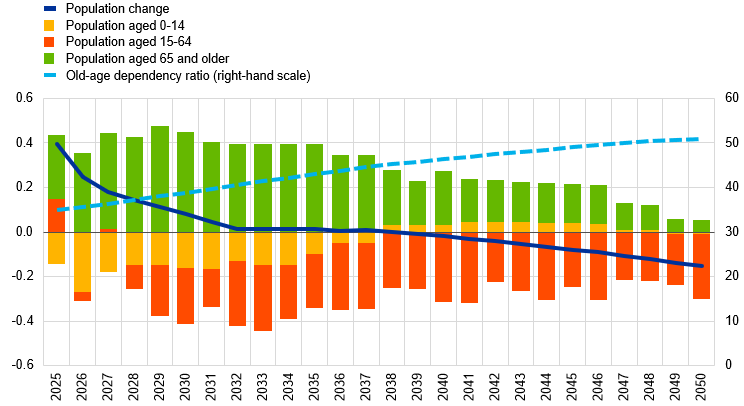
The latest demographic trends suggest that the euro area population will rise temporarily before declining to stand at 358 million in 2050, the same as in 2025, albeit with a different age structure (Chart A). According to the EUROPOP 2025 projections, which were published on 16 April 2026, the population of the euro area is expected to edge up to a peak of 361.4 million in 2037 before falling afterwards.[1] The structure of the population will change significantly: the number of people aged 65 and over will increase, while the number of children (aged 0-14) and people of working age (aged 15-64) will decline.[2] The strong increase in the older population up to the middle of the next decade reflects the fact that a large contingent of the “baby boomer” generation will reach retirement age. There is then a decline in the 15-64 age group as those born during the recent period of low birth rates reach working age.
Chart A
Total population growth projections, age-group contributions and old-age dependency ratio
(left-hand scale: annual percentage changes and percentage point contributions; right-hand scale: percentages)
Sources: Eurostat and ECB calculations.
Notes: The solid blue line shows the projected annual percentage change for the total population in EUROPOP 2025 and the bars represent the percentage point contributions of the different age cohorts. The dashed blue line indicates the old-age dependency ratio, which is defined as the proportion of individuals aged 65 or older relative to the working-age population.
After 2050 the population decline is projected to broadly continue at the same rate and in the same composition as predicted for 2050. This decline – at an average growth rate of around -0.2% per year – is mostly driven by a decrease in the working-age population. It results in an increase in the old-age dependency ratio, which is projected to increase from 35% in 2025 to 51% in 2050 and 62% in 2100.[3] In other words, at present, for every one elderly person there are currently just under three people of working age; this will fall to around two working-age people for every one elderly person in 2050 and significantly below that in 2100.
Population projections for the next two decades have been revised up on account of higher migration inflows (Chart B). Net immigration flows into the euro area over the period from 2022 to 2024 were significantly higher than anticipated in the previous EUROPOP projections, which were published in 2023. This reflects stronger economic immigration and Russia’s war in Ukraine lasting longer than anticipated. For the period from 2022 to 2050, average net immigration was revised up from 1.2 million people per year to around 1.4 million people per year. Spain accounts for more than half of this revision, with the country receiving one-third of the euro area’s projected net inward migration. In line with past patterns, 77% of migrants are projected to be of working age. A further 20% are aged under 15 and thus likely to enter the labour force in the future, boosting potential economic growth.[4] However, these migration projections are surrounded by great uncertainty and imply a ratio of net migration to population that is markedly higher than the long-run historical average. Furthermore, projected inward migration is concentrated in countries like Spain, where migration flows fluctuate considerably over the business cycle and can quickly reverse.
Chart B
Revisions to the euro area population outlook compared with EUROPOP 2023
(absolute difference in thousands of persons)

Sources: Eurostat and ECB calculations.
Notes: Revisions are calculated as the difference between the EUROPOP 2025 and the EUROPOP 2023 demographic projections for the change in population levels relative to 1 January 2025. The left-hand panel shows the yearly difference between the two sets of projections until 2030 and the right-hand panel shows the differences on a decade-by-decade basis. The blue line shows revisions to population stocks on 1 January, including a projection error of around -400,000 for 1 January 2025, while the stacked bars show cumulative revisions to population changes up to and including the respective year.
The euro area population in the longer run has been revised down from the previous EUROPOP projections as a result of significantly lower fertility rates. In EUROPOP 2023 the total fertility rate was assessed to have fallen temporarily because of the pandemic, but the latest data show a more persistent decline. The total euro area fertility rate stood at 1.33 children per woman in 2024 and is projected to decline further until 2026. Like previous projections, EUROPOP 2025 predicts that the fertility rate will recover over the projection horizon, albeit to a lower level. This downward revision is based on certain cross-country convergence assumptions.[5] It can also be explained by several socioeconomic factors affecting fertility around the world, some of which may not reverse in the near future. These include higher levels of female education and economic independence (Kim, 2026), housing shortages (Li, 2024) and the divergence in political opinions between young men and young women (Milosav et al., 2026) potentially making finding a compatible partner more difficult.
The most recent revision to the fertility rate has been the largest since the first EUROPOP in 2008 (Chart C). The European Commission has successively revised down fertility rates across EUROPOP vintages. However, the revision to the fertility rate compared with EUROPOP 2023 is as large as all previous revisions since 2008 – the first year the population projections were published in their current format – combined. Compared with EUROPOP 2008, 13 million fewer children were born or are projected to be born over the period 2020-50. The downward revision compared with EUROPOP 2023 was also sizeable, at -5.7 million. Together with the moderate upward revision to mortality rates, which had not fully returned to pre-pandemic levels by 2024, this fully offsets the stronger net inward migration by 2050. In the second half of the century, despite an assumed further recovery in the fertility rate from 1.46 children per woman in 2050 to 1.53 by 2100, the decline in population is more pronounced than in EUROPOP 2023, with the population in 2100 lower by 12 million. The biggest contributors to this fall are Germany (-9.4 million) and Italy (-5.4 million). This is only partly compensated for by Spain (+4.6 million), whose population is projected to be higher than that of Italy in 2100. While the strongest downward revisions are in the 0-14 population group, the working-age population in 2100 is also predicted to be 7 million people lower than projected in EUROPOP 2023. At 175 million, it is significantly lower than the current level of 228 million. However, if future pension reforms result in increased labour force participation, this decrease may not imply such a large drag on the potential growth component.
Chart C
Euro area fertility rate projections across different EUROPOP vintages
(live births per woman)

Sources: Eurostat and ECB calculations.
Note: The fertility rate is defined as the average number of children born to a woman over her lifetime.
The latest demographic outlook is likely to ease the cost-of-ageing pressures on public finances initially before intensifying them later on. The Commission’s 2024 Ageing Report shows that age-related expenditure in the euro area – i.e. public spending on pensions, healthcare, long-term care and education – is projected to increase by 1.3 percentage points under the baseline scenario to reach 26.4% of GDP in 2050. The increase is due mainly to increasing pension and long-term care costs and, to a lesser extent, healthcare costs. Education costs are projected to decrease given the low fertility. According to EUROPOP 2025, the more benign demographic outlook up to around 2050, driven by stronger net immigration, is projected to lead to a lower old-age dependency ratio compared with EUROPOP 2023. This will somewhat ease the funding pressure on age-related expenditure until this migrant population retires. However, the persistence of net immigration is subject to great uncertainty, as the resolution of conflicts, for example, can lead to a reversal of some of these flows. At the same time, the lower fertility rates, a dimension which is more structural in nature than the evolution of net immigration, are lowering the population. This latter factor translates into smaller cohorts entering the labour market, which in turn raises the old-age dependency ratio and the associated funding pressures on pension systems. Therefore, the more positive population developments compared with EUROPOP 2023 for the period up to 2050 should not lead to complacency on the need for pension system reforms.
Overall, a shrinking and ageing population continues to pose significant challenges for the euro area economy. Labour market and pension reforms should be geared towards increasing labour force participation. Higher age-related expenditure and a smaller tax base in the working-age population is likely to put increasing pressure on public finances.[6] In particular, countries that already have vulnerable public finances should refrain from rolling back past pension reforms that have helped improve the sustainability of their pension systems. Rebuilding fiscal buffers that were depleted during the pandemic and energy crises and improving the growth-friendliness of public finances would make it easier to manage the increasing ageing-related costs.
References
Arce, O., Consolo, A., Dias da Silva, A. and Weissler, M. (2025), “Foreign workers: a lever for economic growth”, The ECB Blog, ECB, 8 May.
Bodnár, K. and Nerlich, C. (2022), “The macroeconomic and fiscal impact of population ageing”, Occasional Paper Series, No 296, ECB, June.
Consolo, A., Dias da Silva, A., Furbach, N. and Gomez-Salvador, R. (2026), “Drivers of the labour force in the euro area”, Economic Bulletin, Issue 3, ECB.
European Commission (2024), “2024 Ageing Report – Economic & Budgetary Projections for the EU Member States (2022-2070)”, Institutional Paper, No 279, April.
European Commission (2026), “Population projections in the EU”.
Kim, J. (2023), “Female education and its impact on fertility”, IZA World of Labor.
Li, W. (2024), “Do surging house prices discourage fertility? Global evidence, 1870-2012”, Labour Economics, Vol. 90, October.
Milosav, Ð., Dickson, Z., Hobolt, S.B., Klüver, H., Kuhn, T. and Rodon, T (2026), “The youth gender gap in support for the far right”, Journal of European Public Policy, Vol. 33, Issue 2, pp. 444-468.
Legal Disclaimer:
EIN Presswire provides this news content "as is" without warranty of any kind. We do not accept any responsibility or liability for the accuracy, content, images, videos, licenses, completeness, legality, or reliability of the information contained in this article. If you have any complaints or copyright issues related to this article, kindly contact the author above.
