

Tracking euro area labour market developments through restructuring announcements
Prepared by Claudia Foroni and Nikolaos Papadatos
Published as part of the ECB Economic Bulletin, Issue 4/2026.
This box examines the extent to which media-reported, firm-level restructuring announcements covering both job reductions and job creations can provide more timely signals of euro area labour market dynamics than standard statistical measures. It draws on the European Restructuring Monitor (ERM), a firm-level dataset compiled by the European Foundation for the Improvement of Living and Working Conditions (Eurofound) through the daily screening of national business media and company websites across all EU Member States and Norway since 2002. A restructuring event is recorded when at least 100 jobs are affected, or when the affected workforce represents at least 10% of an establishment employing more than 250 people.[1] Events need to materialise within nine months from the announcement and are classified by type (e.g. internal restructuring, expansion, offshoring, merger or bankruptcy), offering information on the nature of the underlying shock which is not available in standard aggregate statistics. As such, the ERM may provide timely, high-frequency insights into labour market developments ahead of official data releases.
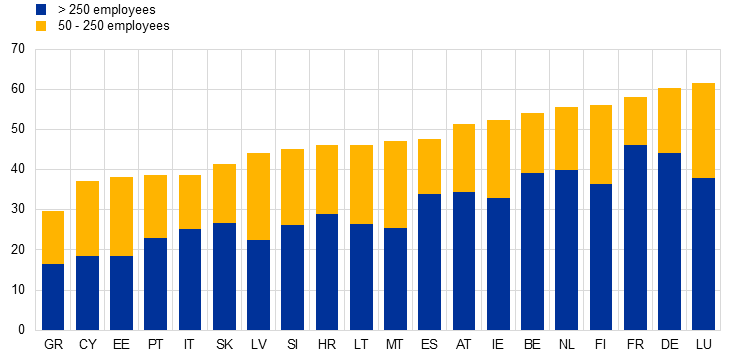
By construction, the coverage of media-reported restructuring announcements is biased towards larger firms – reflecting both reporting thresholds and media attention. This bias implies that the ERM is not representative of total employment, particularly in countries where economic activity is concentrated in smaller enterprises. In the euro area, firms with at least 250 employees represent less than 1% of total enterprises but account for approximately 36% of total employment. Extending the threshold to firms with at least 50 employees raises this share to around 50% (Chart A). Accordingly, the ERM captures restructuring announcements in firms employing between one-third and one-half of the total euro area workforce, although the number of workers directly affected by recorded restructuring announcements is considerably lower. Coverage also varies across countries, reflecting differences in industrial structure and the distribution of employment across firm sizes. Germany and France together account for roughly 40% of all announced restructuring events in the euro area recorded in the ERM. The comparatively smaller number of events recorded for Spain and Italy in large part reflects their lower share of employment in larger firms. Hence, the ERM only captures restructuring among larger employers and remains mostly silent on small-firm employment dynamics as well as aspects such as labour force participation and hours worked. It should therefore be interpreted as a complementary, rather than a comprehensive, indicator of labour market conditions.
Chart A
Share of employment in large firms across euro area countries
(percentage share of total employment)
Source: Eurostat Structural Business Statistics.
Notes: The chart shows the share of employment in firms with more than 250 employees and in firms with 50 to 250 employees, by euro area country. The values refer to averages over the period from 2021 to 2024. The countries are ordered by total share.
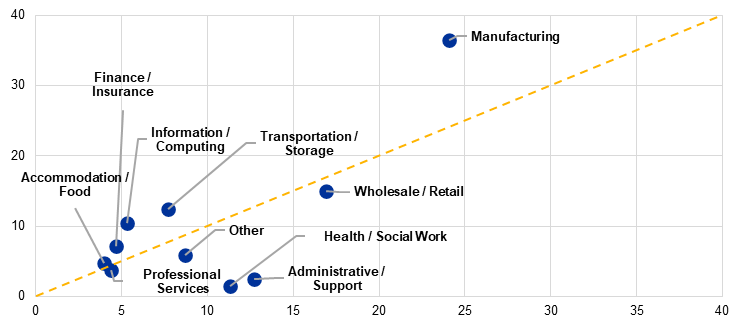
The sectoral distribution of events recorded in the ERM provides information on where large-scale restructuring is most concentrated within the segment of the economy covered by the dataset, offering a descriptive dimension that complements standard aggregate labour market statistics (Chart B). Using Eurostat Structural Business Statistics data on the sectoral composition of employment in larger firms as a benchmark, manufacturing stands out as the most restructuring-intensive sector. It accounts for 37% of total jobs affected by restructuring events, compared with a 24% share of employment in firms with 50 or more employees.[2] By contrast, health, social and administrative services account for a markedly smaller share of affected jobs recorded in the ERM than their share of employment in larger firms. As the ERM is based on media-reported events, it may favour large, visible cases of restructuring and more abrupt forms of adjustment. Given that such reporting biases can vary across sectors, these differences should be interpreted with caution.
Chart B
Sectoral distribution of announced restructuring events and employment in large firms
Sources: Eurofound, Eurostat Structural Business Statistics and ECB staff calculations.
Notes: The vertical axis shows the sectoral distribution of jobs affected by restructuring events recorded in the ERM, covering all restructuring types. The horizontal axis shows the sectoral distribution of employment in firms with 50 or more employees. The ten largest sectors are shown, with all remaining sectors grouped under “Other”. The dashed line is the 45-degree line, along which a sector's share of restructuring events equals its share of employment in large firms; sectors above the line are over-represented in restructuring activity relative to their share of employment. Data refer to averages over the period from 2021 to 2024, reflecting the most recent period for which sectoral employment data from Eurostat Structural Business Statistics are consistently available and comparable across countries and sectors, following changes in statistical classifications and data coverage in earlier years.
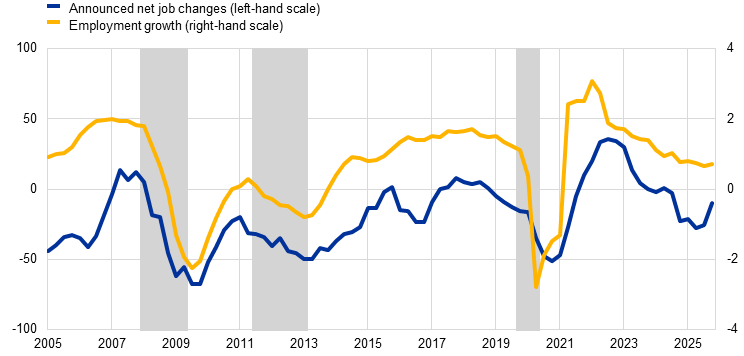
Based on the difference between jobs created and destroyed, an indicator of announced net job changes (NJC) can be calculated, which broadly moves along with euro area employment growth. The NJC indicator is defined as seasonally adjusted announced jobs created minus announced jobs destroyed recorded in the ERM. Using data from 2005 onwards, the sample contains around 190 observations per quarter on average, corresponding to approximately 52,000 announced job losses and 33,000 announced job gains. Job losses exceed job gains on average even though aggregate employment rose over the sample period. This reflects the construction of the database as large-scale job cuts tend to take the form of discrete, well-publicised events that readily cross the ERM reporting thresholds, whereas hiring is typically more gradual, less likely to trigger a qualifying event and attracts less media attention. Nevertheless, when expressed as a four-quarter moving average, the NJC indicator broadly co-moves with euro area employment growth and, more importantly, matches its major turning points over the sample period (Chart C).
Chart C
Euro area employment growth and announced net job changes
(left-hand scale: thousands of jobs; right-hand scale: percentages)
Sources: Eurofound, Eurostat and ECB staff calculations.
Notes: The seasonally adjusted net job changes recorded in the ERM are shown as a four-quarter backward-looking moving average. Euro area employment growth is shown year on year. The shaded areas indicate euro area recessions as identified by the Euro Area Business Cycle Network of the Centre for Economic Policy Research. The data cover the period from the first quarter of 2005 to the first quarter of 2026.
A model-based analysis shows that restructuring announcements contain meaningful leading information about the developments in euro area employment growth. A probit model using announced net job changes is applied to estimate the probability of year-on-year euro area employment growth falling below its historical sample average. By incorporating lagged values of the NJC indicator, the model provides a timely and complementary source of information on labour market conditions alongside official employment statistics, helping to track the reversal of employment growth back to above-average levels (Chart D).
Chart D
Predicted probability of below-average euro area employment growth
(probability)

Sources: Eurofound, Eurostat and ECB staff calculations.
Notes: The chart shows the predicted probability of below-average euro area employment growth from a probit model using contemporaneous announced net job changes along with the indicator’s three lags. Below-average growth is defined as year-on-year employment growth below the historical sample average of 0.7%. The yellow shaded areas indicate quarters of realised below-average employment growth. The horizontal line marks a probability threshold of 0.5. The data cover the period from first quarter of 2005 to the first quarter of 2026.
Recent restructuring announcements suggest that employment growth may remain below its historical average in the first half of 2026. Euro area employment growth has slowed to around or below its historical average since mid-2025, while model-based probabilities of below-average employment growth also rose over the course of the year. Although somewhat volatile, these probabilities indicate a continued likelihood of below-average growth in the first quarter of 2026, consistent with the realised annual employment growth rate of 0.6%. Data for April and May point to a likelihood of continued weak employment growth in the second quarter, albeit with a somewhat more positive balance of restructuring announcements. At the country level, France and Spain are the main drivers of this improvement, with positive net job changes in both economies. In Germany, job reductions continue to outpace job creations. At the sectoral level, the information and computing sector, alongside public administration and defence, continue to make a positive contribution. By contrast, manufacturing is moving into a more negative net position, with jobs destroyed increasingly outpacing jobs created relative to the broadly neutral balance observed in the first quarter.
References
European Foundation for the Improvement of Living and Working Conditions (Eurofound) (2025), “European Restructuring Monitor (ERM)”.
Litardi, C. and Brattlund, E. (2025), “European Restructuring Monitor: The database and its methodology”, Working Paper, No WPEF25058, European Foundation for the Improvement of Living and Working Conditions (Eurofound), 18 September.
European Commission, Directorate-General for Employment, Social Affairs and Inclusion (2025), “Labour Market and Wage Developments in Europe 2025”, Publications Office of the European Union, Luxembourg.
Legal Disclaimer:
EIN Presswire provides this news content "as is" without warranty of any kind. We do not accept any responsibility or liability for the accuracy, content, images, videos, licenses, completeness, legality, or reliability of the information contained in this article. If you have any complaints or copyright issues related to this article, kindly contact the author above.
