

The best news from Germany on finance and banking
Provided by AGP
Drivers of the labour force in the euro area
Prepared by Agostino Consolo, António Dias da Silva, Nina Furbach and Ramon Gomez-Salvador
1 Introduction
The euro area labour force has expanded significantly in recent years, driven by rising participation rates, demographic shifts and sustained net migration. The labour force comprises all individuals of working age – which we define as those aged 15 to 74 to account for longer working lives – who are either in employment or actively seeking work. The share of the working-age population participating in the labour force, known as the “participation rate”, has increased across multiple dimensions in recent years: the share of women in employment has risen, narrowing long-standing gender gaps; older workers have remained active for longer, partly reflecting pension reforms and a secular shift towards less physically demanding occupations; and successive cohorts with higher educational qualifications have entered the labour force, which supports labour force expansion given that the higher educated tend to have higher participation rates. Alongside these domestic trends, net migration has been persistently positive since around 2010, with non-EU workers becoming an increasingly important driver of labour force growth.
Older workers and migrants have been the two most important sources of labour force expansion in recent years, each having distinct effects on aggregate labour market outcomes. Both groups have grown not only in terms of population, but also in terms of participation rates. Older workers, who typically exhibit lower unemployment rates, have exerted a structural downward pull on the aggregate unemployment rate. Migrants tend to have higher unemployment rates, but recent evidence suggests that much of the increase in labour supply from this group has translated directly into employment, thereby limiting the upward pressure on the unemployment rate.
The number of hours worked has not followed the trend in the number of persons employed, with average hours per employee remaining below levels seen before the COVID-19 pandemic in several euro area countries. Although the number of persons employed has grown sharply, the average number of hours worked per employee has fallen. This reflects compositional effects (e.g. older workers and women work fewer hours per week on average) as well as broader shifts in working patterns. This divergence matters for the assessment of economic activity, as growth in gross domestic product (GDP) depends not only on the number of people in employment but also on the intensity with which labour is used.
The expansion and the changing composition of the labour force have significant implications for potential output, equilibrium unemployment and labour market dynamics. Labour force growth has directly supported potential output at a time when investment and total factor productivity have been subdued. The shift towards older and more educated workers has both lowered unemployment and reduced labour market dynamism, while the growing share of foreign workers has helped to contain labour shortages in key sectors of the euro area economy. However, less market fluidity and lower shares of young people in the population may jeopardise entrepreneurship and drag productivity down. At the same time, the rise in the average age at which individuals first produce notable innovations, the adoption of new technologies and the availability of age-friendly jobs may mitigate the negative effects of population ageing.[1]
This article analyses these developments in the euro area labour force and discusses their consequences for growth and labour market dynamics. Section 2 examines how strong labour force growth has supported GDP growth in recent years. Section 3 describes labour force participation across age, gender and education levels and provides a detailed assessment of ageing and its consequences for future labour supply. Section 4 analyses the contribution of foreign workers to euro area labour force growth. Section 5 examines the implications of the changing composition of the labour force for labour market volatility and dynamics, including average hours worked. Section 6 concludes.
2 The contribution of the labour force to GDP growth
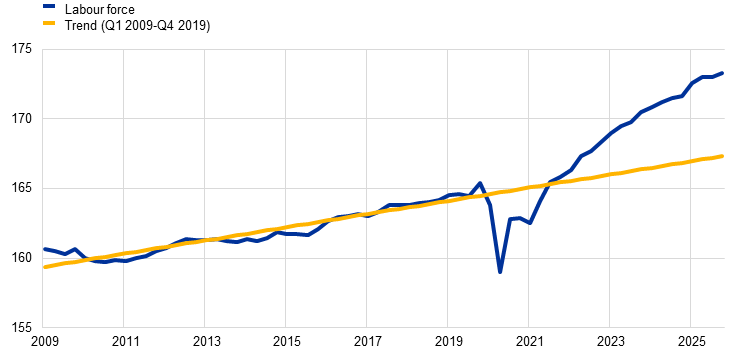
The euro area labour force has expanded rapidly over the past five years. It has risen by 7.8 million since the fourth quarter of 2019 and reached 173 million in mid-2025 (Chart 1). This increase is substantial when compared with the previous ten years. Had the labour force grown in line with the trend observed between 2009 and 2019, it would currently stand at around 167 million, 5.9 million below the current level. The rise in the labour force since the fourth quarter of 2019 reflects two factors: an increase in total working-age population, which has grown by 5.8 million, and a rise in the labour force participation rate, which increased from 64.6% in the fourth quarter of 2019 to 66.2% in the fourth quarter of 2025. Foreign workers account for most of the increase in the working-age population.[2]
Chart 1
Labour force developments
(millions of people)
Sources: Eurostat and ECB staff calculations.
Notes: The linear trend is calculated for the period from the first quarter of 2009 to the fourth quarter of 2019. The latest observation is for the fourth quarter of 2025.
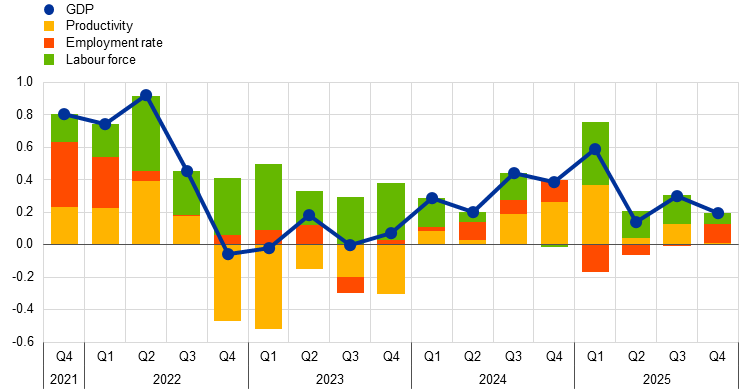
The increase in the labour force has been an important factor supporting GDP growth in recent years. Since the third quarter of 2021, the labour force and the employment rate (those working as a share of the labour force) have together accounted for more than half of GDP growth in most quarters (Chart 2). Over this period, labour (the combined contribution of labour force growth and changes in the employment rate) has been the most consistent positive contributor to GDP growth. This pattern reflects a broader feature of the post-pandemic recovery in the euro area (particularly in 2022 and 2023), which is that growth has been unusually labour-intensive, relying more heavily on growth in the number of people in employment than on productivity gains (Berson et al., 2024; Arce and Sondermann, 2024; Consolo et al., 2026). This pattern was partly reversed in 2024 and 2025, with productivity growth recovering. The following sections examine the drivers of this expansion in labour supply, including developments in participation rates, the role of older workers and the contribution of migration.
Chart 2
The contribution of the employment rate and labour force to GDP growth
(quarter-on-quarter percentage changes for GDP; percentage point contributions for other variables)
Sources: Eurostat and ECB staff calculations.
Notes: The employment rate used here is the number of employed persons as a share of the total labour force (the employed plus the unemployed). The latest observations are for the fourth quarter of 2025.
3 Labour force developments: age, skills and gender
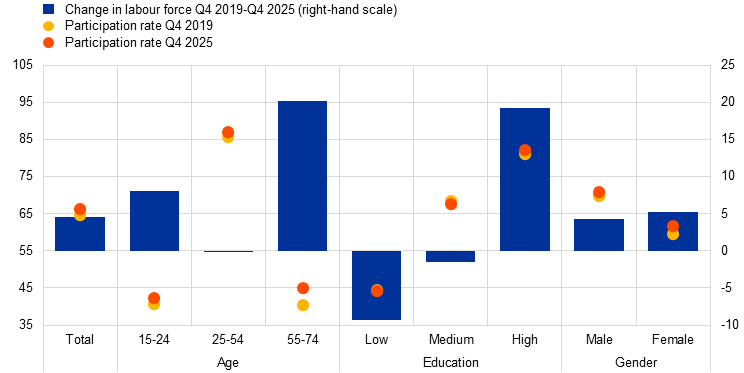
The composition of the euro area labour force has shifted markedly since 2019, with growing shares of older and highly skilled workers. The number of workers aged 55-74 increased by 20.2% between the fourth quarter of 2019 and the fourth quarter of 2025, while the number of workers with tertiary education rose by 19.3% over the same period (Chart 3). The share of older workers in the labour force increased from around 20% in 2019 to 23% in 2025, while the share of workers with tertiary education rose from 34% to 39%. These changes were driven not only by ageing and upskilling but also by increased participation rates.
Chart 3
Participation rates and changes in the labour force by demographic group
(left-hand scale: percentages of the working-age population; right-hand scale: percentage changes)
Sources: Eurostat and ECB staff calculations.
Participation rates increased across most demographic groups, with the most pronounced gains recorded among older workers and women. The participation rate for the 55-74 age group rose from 40.3% to 44.9% between the fourth quarter of 2019 and the fourth quarter of 2025 (Chart 3). The participation gap between women and men continued to close, with the female labour force growing by 5.2% over the same period, compared with 4.3% for men. Nonetheless, a gap of 9 percentage points remained in the fourth quarter of 2025. While this represents a significant narrowing relative to historical levels, the gap remains substantial, suggesting that structural barriers to female participation (including the availability of childcare, the tax treatment of second earners and sectoral segregation) have not been fully resolved.[3] These shifts in the composition of the labour force towards groups with historically different participation rates have implications for the aggregate participation rate (as also discussed in Box 1).
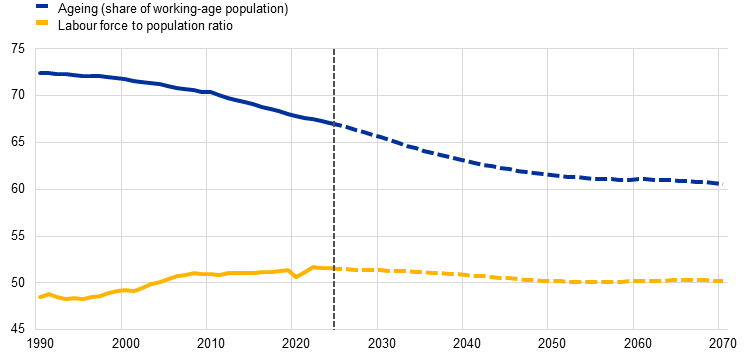
The ageing of the euro area working population has not translated into a commensurate decline in the labour force. While the share of the working-age population as a percentage of the total population has been decreasing since the early 1990s, the labour force as a share of the total population has remained broadly stable and has even edged up relative to its 1990s level (Chart 4). According to the European Commission’s latest Ageing Report, this divergence is expected to persist, driven by a sustained rise in female labour force participation, increasing participation among older workers and continued positive net migration (European Commission, 2024; Abbritti et al., forthcoming).[4],[5]
Chart 4
Ageing and labour force
(percentages)
Sources: World Bank Development indicators and European Commission Ageing Working Group.
Notes: The variable “ageing” is defined as the share of the working-age population (aged 15-64) in the total population. As both the working-age population and labour force are defined in relation to the total population, the chart indicates that the labour force has also been increasing in terms of the number of people.
Population ageing and recent labour force developments have offsetting implications for economic growth and labour market tightness. While demographic ageing alone would tend to put direct downward pressure on economic growth and the labour supply, rising participation rates and sustained net migration can expand the labour supply, helping it to meet demand and mitigating these demographic headwinds.[6]
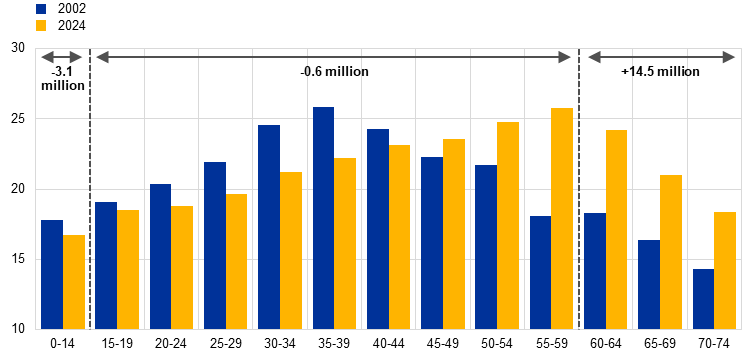
Ageing shifts the euro area population distribution, with implications for key labour market indicators. Ageing reduces the number of people in younger cohorts, while simultaneously increasing the population share in the 60-74 age group (Chart 5). In the context of rising life expectancy and higher statutory and effective retirement ages, these older cohorts are contributing more to the labour force than in previous decades. When assessing the impact of ageing on labour supply, it is therefore important to look at the upper end of the age distribution, where an expanding pool of active older individuals provides a buffer against demographic headwinds. However, persistently low fertility rates are continuing to shrink the share of younger cohorts entering the labour force, meaning that the current rise in the participation of older workers offers only transitional offsetting of the longer-term demographic drag.[7]
Chart 5
Age distribution of euro area population
(millions of people)
Sources: Eurostat and ECB staff calculations.
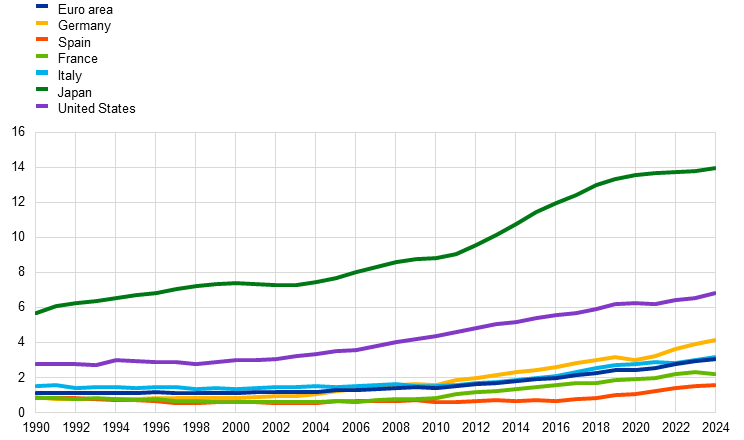
In the euro area there is significant scope to raise labour force participation among older workers relative to other advanced economies. Workers aged 65 and above account for about 3% of the euro area labour force, compared with around 7% in the United States and about 14% in Japan (Chart 6). This gap partly reflects differences in pension system design and institutional settings, but it also points to untapped labour supply in the euro area. Part of this adjustment is already under way, as successive cohorts gradually adapt to higher statutory and effective retirement ages. In addition, rising longevity and improving health in later stages of life are likely to enable a growing share of workers to remain active for longer, particularly in less physically demanding occupations. Taken together, these factors suggest that increased participation among older workers could continue to mitigate the impact of ageing on the euro area labour force, at least over the medium term. However, participation rates across different demographic groups and countries tend to exhibit a ceiling. This puts a limit on the potential offsetting effects of the increase in participation. Migration and technological advancement are therefore essential to help mitigate the economic impact of population ageing.
Chart 6
Workers aged 65 and above as a share of the total labour force
(percentages)
Sources: World Bank Development indicators and ECB staff calculations.
Note: The total labour force comprises all employed and unemployed workers aged 15 and above.
4 Contribution of migration to the euro area labour force
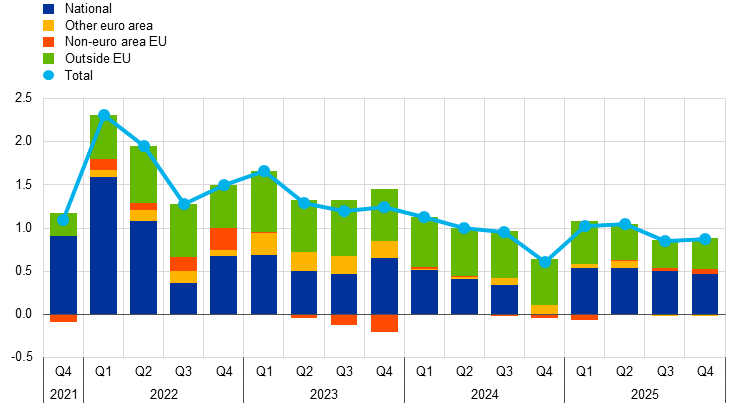
Foreign workers have contributed significantly to the recent growth in the euro area labour force.[8] Although foreign workers only represented about 8% of the total euro area labour force in 2021, they have accounted for more than half of labour force growth over the past four years (Chart 7), equivalent to 4.2 million additional workers, bringing their share up to 10% (Arce et al., 2025).
Chart 7
Labour force growth by nationality
(year-on-year percentage changes; percentage point contributions)
Sources: Eurostat and ECB staff calculations.
Notes: “Non-euro area EU” and “outside EU” refer to individuals who are part of the euro area labour force but are not citizens of euro area countries. The latest observations are for the fourth quarter of 2025.
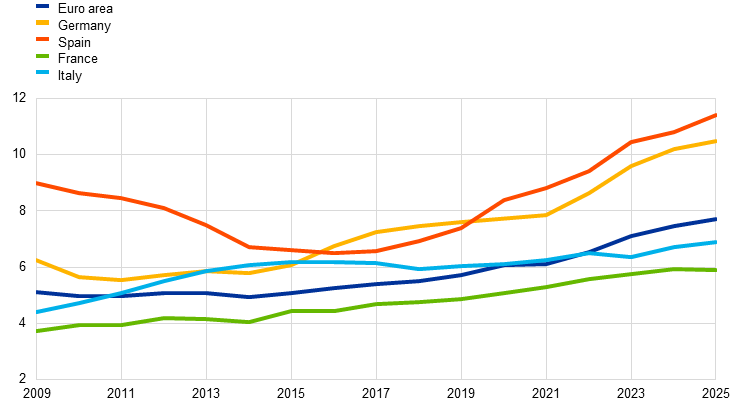
This increase was largely driven by substantial inflows of workers from non-EU countries and their increased participation in the labour force. The growth of the foreign labour force has accelerated, reflecting the arrival of Ukrainians displaced by Russia’s war against their country, many of whom relocated to Germany, and higher inflows of people from Latin American countries to Spain (Chart 8). At the same time, the labour force participation rate of non-EU citizens increased from roughly 64.1% in 2022 to almost 66.6% in 2025. Notably, it has exceeded that of euro area nationals since 2024, despite the steady increase in the participation rate of euro area nationals from roughly 63% to almost 66% over the past decade and the sizeable inflows of Ukrainian refugees with lower participation rates upon arrival and a high share of women (Botelho and Hägele, 2023).
Chart 8
Share of foreign population across major euro area countries
(percentages)
Sources: Eurostat and ECB staff calculations.
Notes: “Foreign population” refers to individuals of working age (15 to 74) with citizenship of countries outside the EU. The latest observations are for 2025.
Even before the strong migration inflows of recent years, workers from non-EU countries represented an increasingly important part of the euro area’s working-age population. The share of non-EU citizens residing in the euro area has steadily increased over the past decade (Chart 8), starting in 2015 with sizeable inflows of refugees from the Middle East and North Africa. Migration flows were temporarily slowed down by the pandemic, but increased at an even faster pace after pandemic restrictions were eased.
Migration from non-EU countries is gaining importance relative to migration from EU countries. Trends in migration patterns over time and across major euro area countries suggest that migration is driven not only by developments in the countries of origin but also by economic conditions and migration policies in the destination countries.[9] Lower economic growth in the euro area compared with some central and eastern European countries and the fading impact of policy changes in the context of the EU enlargement process might explain why migration from EU countries outside the euro area has become less significant than migration from non-EU countries. The share of migrants from non-euro area EU countries has remained at roughly 1.7% since 2020, following a period of very strong inflows before the pandemic.[10] Looking ahead, evolving demographic trends and resulting labour shortages (see Section 3) are likely to act as a pull factor for migration from non-EU countries. Given their large and growing contribution to the euro area labour force, the remainder of this section focuses on non-EU citizens.
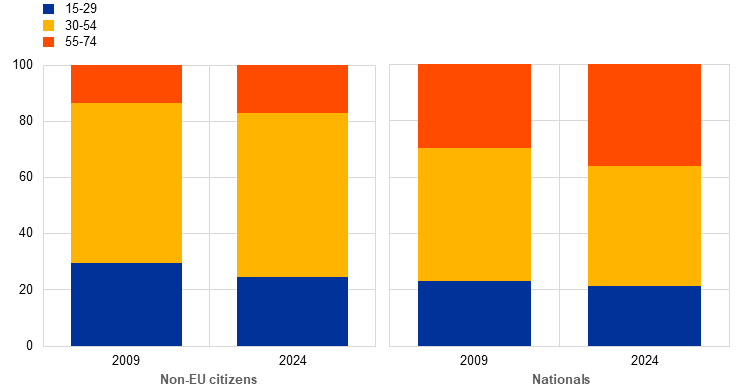
There are notable differences between migrants and euro area nationals: first, migrants from outside the EU are on average younger. The share of young individuals (aged 15-29) in the working-age population is slightly higher for non-EU citizens, while the share of older individuals (aged 55-74) is considerably lower and has increased to a much smaller extent since 2009 (Chart 9, panel a). This may reflect the fact that many people who move countries do so for work reasons, but also that moving between countries is more difficult for older individuals. Owing to the younger age of foreign workers, migration has partially mitigated the demographic drag caused by population ageing in the euro area (see Section 3).
Chart 9
Demographic composition of non-EU migrants and national populations
a) Age
(percentages)
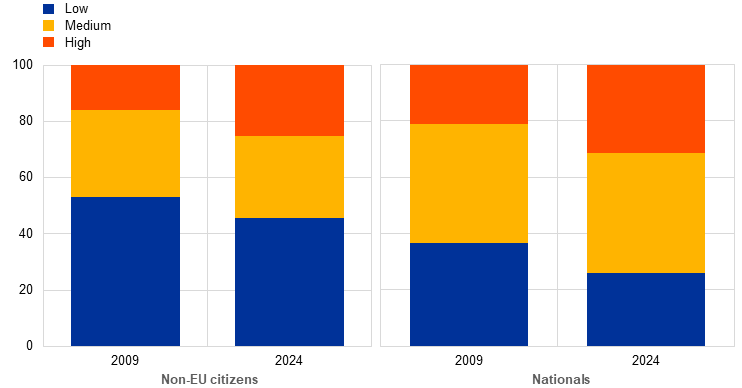
b) Education
(percentages)
Sources: Eurostat and ECB staff calculations.
Notes: Only the working-age population (15 to 74) is covered. Education levels are based on the International Standard Classification of Education (ISCED). A “low” education level means less than primary, primary and lower secondary education (ISCED levels 0 to 2), “medium” covers upper secondary and post-secondary non-tertiary education (ISCED levels 3 and 4), and “high” refers to tertiary education (ISCED levels 5 to 8).
Second, the educational attainment of non-EU migrants is somewhat lower, although it is steadily improving over time. There are more low-skilled individuals and fewer medium and high-skilled individuals among non-EU citizens (Chart 9, panel b) than among the national populations. However, the gap between nationals and non-EU citizens in tertiary educational attainment (“high” skill level) is relatively modest: in 2024, 25% of non-EU citizens held a tertiary degree, compared with 31% of nationals. Educational attainment has increased at a broadly similar pace in both groups. At the same time, Eurostat data show that second-generation migrants catch up entirely with nationals in terms of their education.
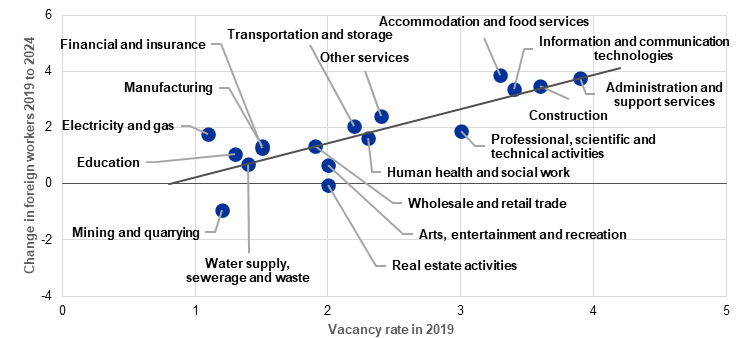
Third, foreign workers tend to join sectors with higher labour demand. Workers with non-EU citizenship have contributed significantly more than nationals to employment growth in sectors facing higher labour shortages as measured by the vacancy rate (Chart 10, panel a). These include some sectors requiring higher skills (such as information and communication services) and some requiring lower skills (such as accommodation and food services and construction).
Chart 10
Sectoral allocation and job matching of non-EU citizens
a) Changes in the share of foreign workers and vacancies across industries
(x-axis: percentages, y-axis: percentage points)
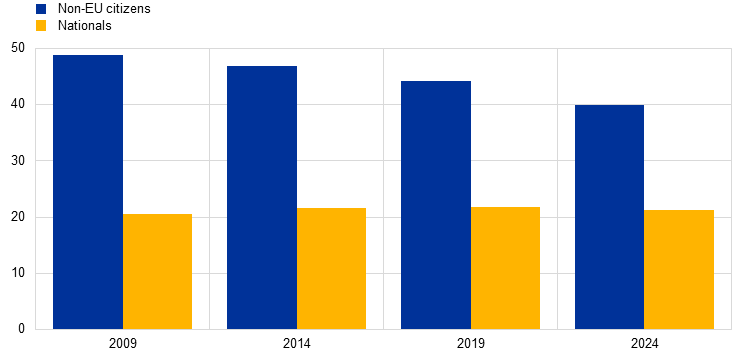
b) Overqualification rates
(percentages)
Sources: Eurostat and ECB staff calculations.
Notes: Panel a): the change in foreign workers from 2019 to 2024 is calculated as the percentage point change in the share of workers with non-EU citizenship. Only the working-age population (age 15 to 74) is covered. Panel b): the overqualification rate is calculated as persons aged 15-64 with tertiary education (ISCED levels 5 to 8) who are employed in low or medium-skilled occupations (International Standard Classification of Occupations major groups 4 to 9).
Matching the qualifications of foreign workers to the right jobs remains a key challenge. Taken together, the evidence suggests that increased migration has contributed to the easing of both labour and skills shortages. However, efficient matching of qualifications to occupations is crucial to maximise the gains from migration. In 2024 the overqualification rate – the proportion of individuals with tertiary education working in medium and low-skilled occupations – was as high as 40% for non-EU citizens, nearly twice as high as for nationals (Chart 10, panel b). The gap has narrowed significantly since 2009, suggesting better alignment of the qualifications of foreign workers with job requirements, but there is still ample room for improvement. Overqualification is also a drag on productivity, as workers employed below their skill level are not contributing their full potential.
Box 1
A comparison of labour force participation trends in the euro area and the United States
Prepared by Ramon Gomez-Salvador and Til Pommer
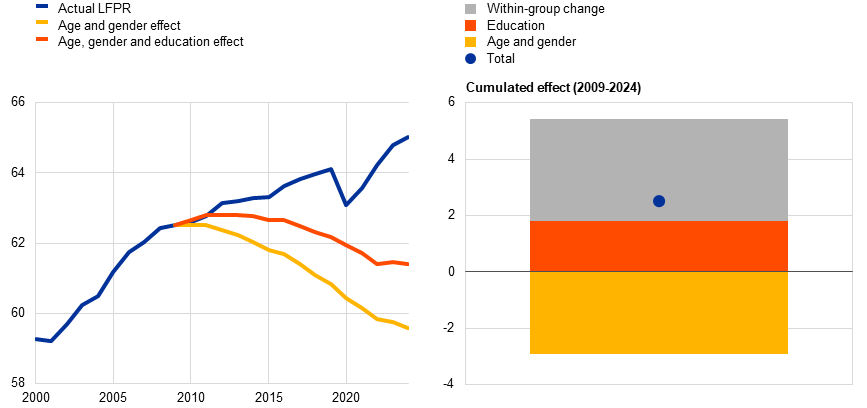
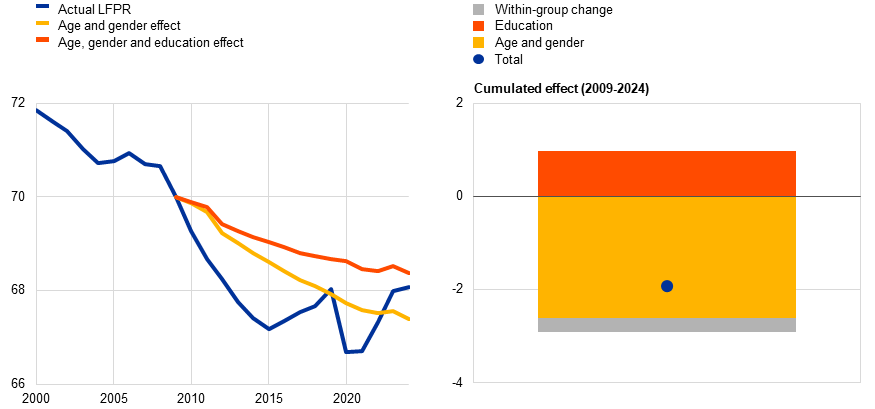
In 2024 the labour force participation rate (LFPR) for the 15-74 age group averaged 65.7% in the euro area, 2.3 percentage points lower than the rate for the United States. This gap, which was marginally wider for men than for women, has been closing over recent years. Compared with 2009, the LFPR has increased by 3.1 percentage points in the euro area (particularly for women) while it has declined by 2 percentage points in the United States (mostly for men), reducing the gap between the euro area and the United States by around 5 percentage points.[11] This box looks at long-run trends in the euro area and the United States to determine how the shift towards an older and more educated population is affecting the LFPR. The analysis uses micro data and follows an approach taken by the Federal Reserve System which allow us to create 44 distinct groups combining two genders, seven age categories (15-19, 20-24, 25-34, 35-44, 45-54, 55-64 and 65-74) and four educational categories for those above the age of 24 (high school, some college education, bachelor’s degree, and master’s degree or higher).[12] Using these data, we run a shift-share analysis and also estimate trend developments across groups.
To quantify how much developments in the aggregate LFPR since 2009 are driven by demographic changes, we construct two scenarios: scenario 1 fixes the participation rate of each age-gender group at 2009 levels and uses the actual population shares as weights up to 2024 (yellow lines in Chart A); scenario 2 adds the educational distribution and allows the educational levels of each age-gender group to move with the data (red lines). These counterfactuals isolate the impact of changes in the participation rate caused solely by demographic shifts.
The results indicate that age and gender compositional changes are pushing participation rates lower in both the euro area and the United States. This reflects the fact that population ageing is moving an increasing share of the population into age groups with lower labour force participation (cumulated effect between 2009 and 2024 shown by the yellow bars in Chart A). Educational attainment partially offsets the negative contribution of population trends – more visibly in the euro area than in the United States – showing the positive impact of education on labour force participation (red bars). The main difference between the two economic areas are within-group changes that contributed positively and significantly to euro area participation, while having a small negative impact on US participation (grey bars).[13]
Chart A
Euro area and US participation rates and drivers
a) Euro area
(percentages; percentage points)
b) United States
(percentages; percentage points)
Sources: US Current Population Survey, EU Labour Force Survey (EU-LFS) and ECB staff calculations.
Notes: The LFPRs shown cover the 15-74 age range for the euro area and the 16-74 age range for the United States. For each sub-group, LFPRs are fixed in 2009, while the actual group shares are applied. The “within-group” change is defined as the difference between the total LFPR change and age, gender and education effects. The latest observations are for 2024.
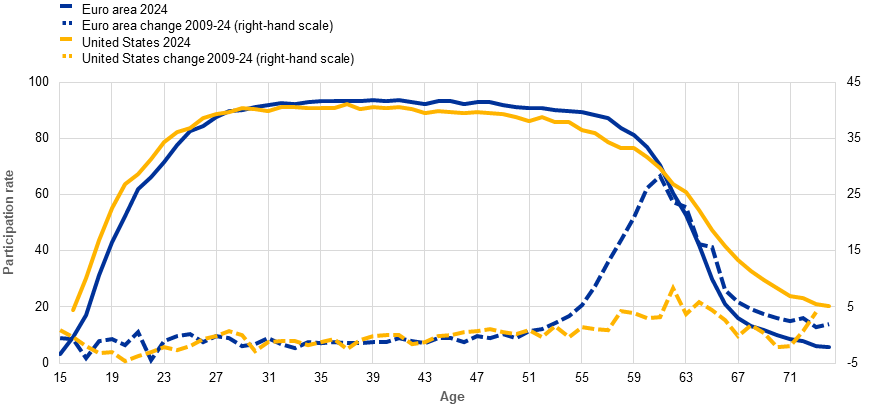
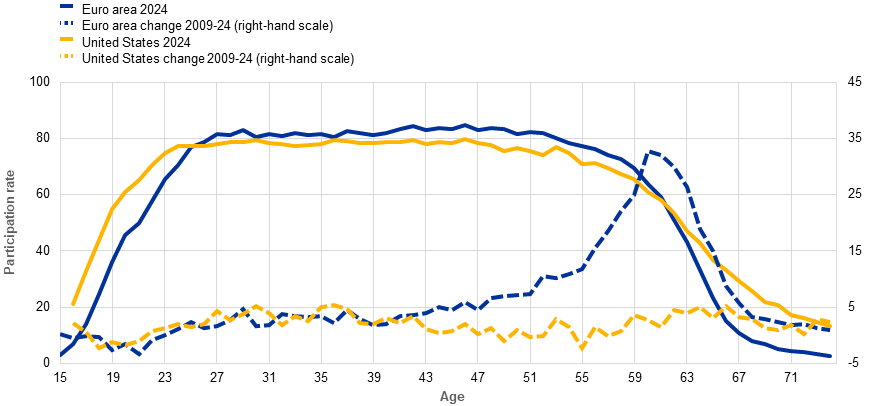
To further explore the within-group changes, we examine how LFPRs have evolved across specific age and gender groups (Chart B). As regards female participation, in both the euro area and the United States we observe a broad-based increase in LFPRs across age groups. But the increase in the euro area is more marked for women aged 55-64 (over 20 percentage points), while in the United States the increase is more limited and concentrated at the lower end of the prime (25-54) age group. Turning to male participation, there are also some common patterns, such as the increase in LFPRs in the oldest groups (over 54 years). However, in the euro area this increase is not only more significant (especially in the 60-65 age group, for which the LFPR increased by 4.7 percentage points in the United States and 22.1 percentage points in the euro area) but also continues across older age groups. Across younger male age groups, participation rates have been broadly stable since 2009, the only exception being for under 25 year-olds, for whom a slight decline is visible, particularly in the United States.
Chart B
Participation rates by age and gender
a) Male
(left-hand scale: participation rate in 2024, percentages; right-hand scale: change in participation rate 2009-24, percentage points)
b) Female
(left-hand scale: participation rate in 2024, percentages; right-hand scale: change in the participation rates 2009-24, percentage points)
Sources: US Current Population Survey, EU Labour Force Survey (EU-LFS) and ECB staff calculations.
Note: The latest observations are for 2024.
These changes in participation rates within demographic groups have various causes. In the euro area, more older workers have remained in the labour force. This is in part due to later retirement, pension reforms and longevity (see Section 3). Furthermore, the female participation rate has increased. This is partly due to policy measures aimed at increasing female employment, including subsidised childcare for working parents with young children, tax changes and improved leave (Berson and Botelho, 2023). In the United States, male participation rates have been falling across all age ranges, but particularly for those under 35 owing to prolonged investment in formal education. By contrast, prime-age female participation rates are pushing up overall participation, with white and Hispanic women leading this trend. In both groups, the younger generations are generally participating in the labour market at higher rates than their predecessors (cohort effect), but for Hispanic women this has been reinforced by a pronounced increase in participation as they move through their prime working years (age effect).
5 Implications for labour market dynamics
The expansion and the changing composition of the euro area labour force have significant implications for key labour market indicators and average hours worked. This section examines two dimensions of this. First, the changing composition of the labour force has implications for assessing the level and volatility of the unemployment rate and for gauging labour market fluidity.[14] Second, beyond the number of people in the labour force (the “extensive margin”), the euro area labour market is continuing to see a declining trend in average weekly hours worked per worker (the “intensive margin”). As a result, not all of the increase in the labour force translates into a commensurate increase in labour input, as labour force growth is partly offset by the decline in average hours worked.
Measuring unemployment and labour market fluidity
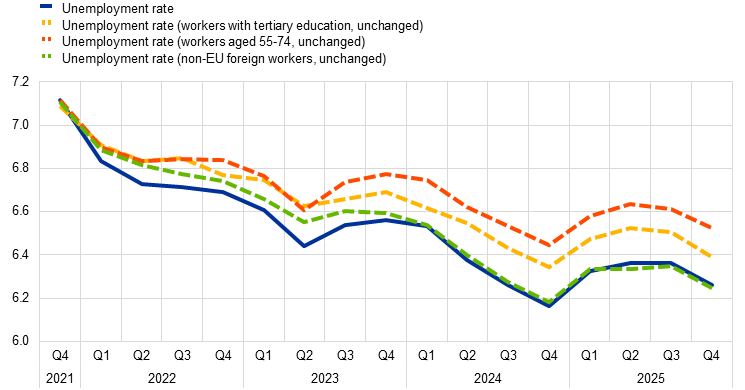
The changing composition of the labour force has exerted significant downward pressure on the unemployment rate. As shown in the preceding sections, older workers and migrants have been the primary drivers of labour force growth, alongside a broad-based upskilling of the workforce. Given that unemployment rates vary considerably across demographic groups, these compositional shifts have important implications for the measurement of aggregate unemployment (Chart 11, panel a). The growing share of older workers and workers with tertiary education, both of which have significantly lower unemployment rates than the overall average, has exerted persistent downward pressure on the aggregate unemployment rate. Older workers in particular tend to transition from employment directly into inactivity rather than into unemployment, leaving the aggregate unemployment rate largely unaffected by their exit from the labour force (Berson, Dias da Silva et al., 2025). Similarly, the increase in the share of foreign workers in the labour force has not led to an increase in the total unemployment rate, because the unemployment rate for that group has fallen by more than the rate for national workers. Since the fourth quarter of 2021, the unemployment rate for foreign workers has declined from 12% to 10.5% (fourth quarter of 2025), while the rate for nationals has declined from 6.5% to 5.6%. Although non-EU citizens still exhibit higher unemployment rates than nationals, this gap has narrowed significantly since 2021. Crucially, the overall unemployment rate has not risen as a result of migration, because new arrivals have largely filled positions in sectors facing acute labour shortages rather than displacing existing workers or adding to the pool of jobseekers. These changes have helped to lower the unemployment rate to levels not observed since the early 1980s, a trend that started before the pandemic (Botelho and Dias da Silva, 2019).
Chart 11
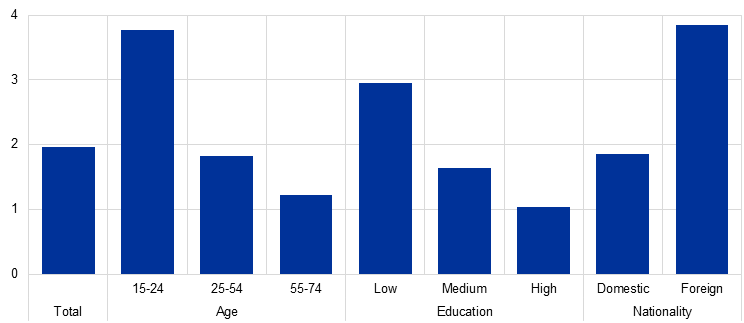
Unemployment rate: level and volatility
a) Labour force composition and unemployment rate
(percentages)
b) Unemployment rate volatility
(standard deviation)
Sources: Eurostat and ECB staff calculations.
Notes: Panel a): in the counterfactual scenarios, the unemployment rates and labour force figures for non-EU labour, workers with a tertiary education and older workers remain at their fourth quarter of 2021 levels. The latest observations are for the fourth quarter of 2025. Unemployment rates and labour force figures are seasonally adjusted. Panel b): for the total unemployment rate and each demographic group, the bars show the standard deviation over the period from the first quarter of 2009 to the fourth quarter of 2025.
The volatility of the unemployment rate has also been affected by these shifts in the labour force. While ageing and migration can be thought of as long-term structural drivers of the unemployment rate in terms of its level, they also affect its cyclicality and volatility, which has implications for its sensitivity to the business cycle and for the assessment of labour market tightness that is relevant for monetary policy. Younger workers exhibit substantially higher unemployment rate volatility than middle-aged and older workers, meaning that a labour force increasingly weighted towards older cohorts may display a more muted unemployment response over the cycle than historical patterns would suggest (Chart 11, panel b).[15]
A higher share of older workers in the labour force reduces labour market dynamism, with implications for the cyclical behaviour of unemployment. It is well established that as workers accumulate tenure, they engage less in job searches and experience fewer job-to-job transitions.[16] Evidence from the ECB Consumer Expectations Survey confirms a steady decline in such transitions with age. Over the period 2022-25, more than 5% of workers aged 18-29 experienced a job-to-job transition each quarter, compared with just 1% of those aged 55-74 (Chart 12). Moreover, older workers who exit employment are more likely to transition directly into inactivity (through retirement or early exit from the labour market) than into unemployment. Taken together, these patterns suggest that the ongoing ageing of the labour force is likely to reduce the frequency and duration of spells of unemployment over the business cycle, with significant implications for the assessment of labour market tightness that is relevant to monetary policy. Fewer job-to-job transitions would affect labour market fluidity and the capacity of the euro area economy to adjust to reallocation shocks (Schoefer, 2025; Fuchs-Schündeln, 2025).
Chart 12
Labour market transitions by age group
(percentages of the origin status)
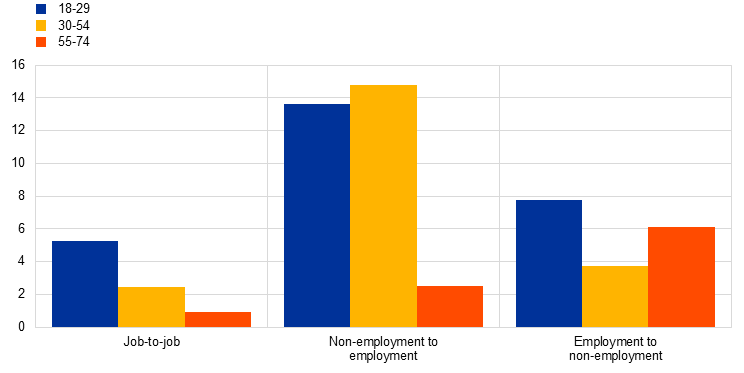
Source: ECB Consumer Expectations Survey.
Note: Quarterly averages for the period 2022-25.
Intensive and extensive margins of labour force participation
To account for the impact of the labour force on total labour input, both the extensive and intensive margins need to be considered. While the labour force has expanded rapidly in recent years, average hours worked per worker are still slightly lower than they were in 2019 (Berson and Weissler, 2025). It is important to consider two factors: first, whether there is a relationship between participation in the labour market and average hours worked in the economy; second, whether the changing composition of the labour force can affect average hours worked.
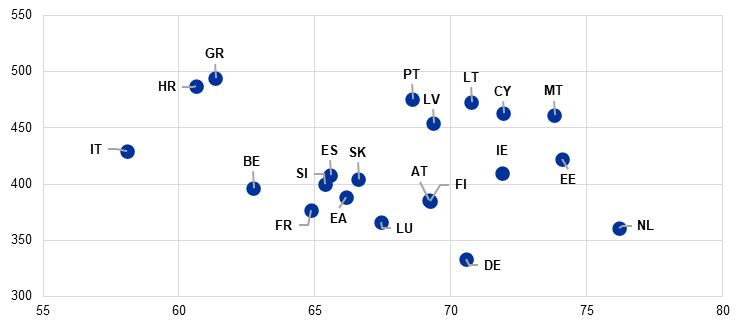
Across euro area countries, there is a negative relationship between participation rates and average hours worked, though the correlation remains modest and cross-country heterogeneity is considerable. Higher participation rates have been associated with lower average hours worked in various euro area countries, with the cross-country correlation standing at -0.18 (Chart 13). Several factors help explain this pattern. On the labour supply side, more flexible working arrangements enable participation among groups that might otherwise remain outside the labour force, such as students, second earners in dual-income households (often women), and older workers transitioning into retirement, typically on a part-time basis, which raises participation while weighing on average hours (Bodnár, 2018; Eiffe et al., 2024). On the structural side, service-oriented economies tend to feature a higher incidence of part-time work than those with a larger manufacturing base, further contributing to the negative relationship between labour force participation and hours worked.
Chart 13
Participation rate and average hours worked
(y-axis: quarterly hours worked per worker; x-axis: participation rate, percentages of the working-age population)
Sources: Eurostat and ECB staff calculations.
Note: Average hours and participation rates for 2025.
The intensive margin is also shaped by the composition of the labour force. Average weekly hours vary considerably across demographic groups (Chart 14). Prime-age workers (aged 25-54) work the longest hours, while both younger workers (aged 15-24) and older workers (aged 55-74) work notably fewer hours per week. As the share of older workers rises with population ageing, this will, all else being equal, exert downward pressure on average hours worked across the economy. A similar compositional effect operates through gender. On average, women work significantly fewer hours in paid occupations than men. Therefore, while clearly positive for the extensive margin, their increasing labour force participation weighs on average hours worked at the aggregate level. The skills dimension tells a somewhat different story. Average hours worked appear broadly similar across low, medium and high-skilled workers, suggesting that the ongoing upskilling of the labour force is unlikely to meaningfully offset the demographic and gender-related pressures on hours worked. Overall, while compositional shifts in the labour force have supported participation, some of the groups driving that increase – older workers, women and younger workers – tend to be associated with shorter working hours. This creates a structural tension between the extensive and intensive margins: gains on the extensive margin may not translate fully into higher labour input owing to a lower intensive margin. It should be noted that not all of the decline in average hours worked reflects voluntary choices: some part-time workers would prefer to work longer hours, suggesting that the headline labour force expansion may overstate the effective increase in labour input from a monetary policy perspective.
Chart 14
Weekly hours worked by demographic group
(number of hours worked per week)
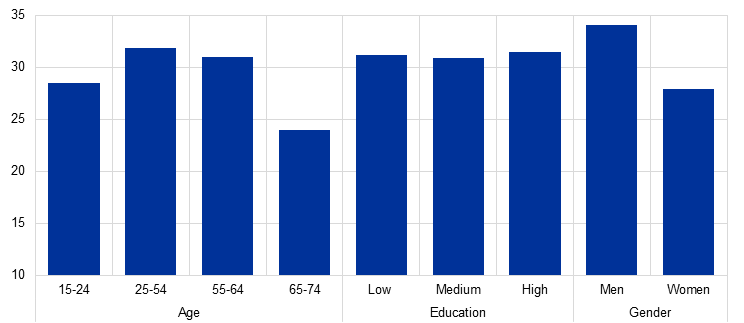
Sources: Eurostat and ECB staff calculations.
Note: Average weekly hours worked in 2024.
6 Conclusion
The rising participation rates of both national and foreign workers have supported labour force growth in recent years. However, as participation rates among older and highly skilled workers rise, the scope for further gains may narrow. In addition, geopolitical developments and policy choices are creating significant uncertainty around migration flows. Changes in the composition of the labour force are affecting the adjustment of the labour market over the business cycle, as these continue to dampen labour market dynamism by reducing job-to-job transitions and compressing the cyclical responsiveness of unemployment.
These drivers of labour supply have alleviated labour market tightness and have had important consequences for wage growth and inflation. The ECB’s 2025 monetary policy strategy assessment highlights the importance for monetary policy of understanding the interactions between cyclical and structural factors that affect labour market conditions. In the euro area, an increase in the labour supply has offset the decline in the working-age population arising from population ageing, thereby helping to satisfy the increase in labour demand in the post-pandemic period. This dynamic is expected to continue in the medium term, driven by the convergence of participation rates across demographic groups.
Technological advances, particularly artificial intelligence (AI), could play an important role in mitigating the impact of ageing on economic growth. The adoption of AI and automation technologies have the potential to boost economic growth and partly offset the demographic decline. However, the pace and distributional consequences of this transition remain highly uncertain, and the interaction between technological change and demographic developments will continue to warrant close monitoring.
Policy can play an important complementary role in supporting labour force participation and mitigate the impacts of the ageing population for an extended period. Well-designed measures to support female labour force participation (including affordable childcare and flexible working arrangements) can help close the remaining female participation gap, expand structural labour supply and help sustain potential output. In addition, migration policy has an important role to play in attracting and retaining workers with skills and profiles that match current and prospective labour demand. At the same time, education and training policies that facilitate the reskilling of workers displaced by technological change will be essential to increase productivity and ensure that productivity gains from AI and automation are broadly shared.
References
Abbritti, M., Cimadomo, J. and Consolo, A. (forthcoming), “Ageing and the wealth of labour”, Working Paper Series, ECB.
Abbritti, M. and Consolo, A. (2024), “Labour market skills, endogenous productivity and business cycles”, European Economic Review, Vol. 170, November.
Acemoglu, D., Søndergaard Mühlbach, N. and Scott, A.J. (2022), “The rise of age-friendly jobs”, The Journal of the Economics of Ageing, Vol. 23, October.
Anderton, R., Botelho, V., Consolo, A., Dias da Silva, A., Foroni, C., Mohr, M. and Vivian, L. (2020), “The impact of the COVID-19 pandemic on the euro area labour market”, Economic Bulletin, Issue 8, ECB.
André, C., Gal, P. and Schief, M. (2024), “Enhancing productivity and growth in an ageing society: Key mechanisms and policy options”, OECD Economics Department Working Papers, No 1807, OECD Publishing, Paris, June.
Arce, Ó., Consolo, A., Dias da Silva, A. and Weissler, M. (2025), “Foreign workers: a lever for economic growth”, The ECB Blog, ECB, 8 May.
Arce, Ó. and Sondermann, D. (2024), “Low for long? Reasons for the recent decline in productivity”, The ECB Blog, ECB, 6 May.
Arlia, D., Berson, C. and Consolo, A. (2025), “And yet we move: evidence on job-to-job transitions in the euro area”, Economic Bulletin, Issue 7, ECB.
Balleer, A., Gomez-Salvador, R. and Turunen, J. (2014), “Labour force participation across Europe: a cohort-based analysis”, Empirical Economics, Vol. 46, June, pp. 1385-1415.
Berson, C. and Botelho, V. (2023), “Record labour participation: workforce gets older, better educated and more female”, The ECB Blog, ECB, 8 November.
Berson, C., Botelho, V., Dias da Silva, A., Foroni, C., Mohr, M., Schroeder, C. and Weissler, M. (2024), “Explaining the resilience of the euro area labour market between 2022 and 2024”, Economic Bulletin, Issue 8, ECB.
Berson, C., Botelho, V., Guirola Abenza, L., Hospido, L., Kuik, F., Nickel, C. and Rojo Lopez, M. (2025), “The gender gap at work is closing – but slowly”, The ECB Blog, ECB, 7 March.
Berson, C., Dias da Silva, A. and Weissler, M. (2025), “The role of demographics in recent developments in the unemployment rate”, Economic Bulletin, Issue 1, ECB.
Berson, C. and Weissler, M. (2025), “Who wants to work more? Revisiting the decline in average hours worked”, Economic Bulletin, Issue 3, ECB.
Bodnár, K. and O’Brien, D. (2021), “Labour supply developments in the euro area during the COVID-19 pandemic”, Economic Bulletin, Issue 7, ECB.
Bodnár, K. and O’Brien, D. (2022), “The role of migration in weak labour force developments during the COVID-19 pandemic”, Economic Bulletin, Issue 1, ECB.
Bodnár, K. and Nerlich, C. (2020), “Drivers of rising labour force participation – the role of pension reforms”, Economic Bulletin, Issue 5, ECB.
Bodnár, K. and Nerlich, C. (2022), “The macroeconomic and fiscal impact of population ageing”, Occasional Paper Series, No 296, ECB, June.
Bodnár, K. (2018), “Recent developments in part-time employment”, Economic Bulletin, Issue 2, ECB.
Botelho, V. and Dias da Silva, A. (2019), “How does the current employment expansion in the euro area compare with historical patterns?”, Economic Bulletin, Issue 6, ECB.
Botelho, V. and Hägele, H. (2023), “Integrating Ukrainian refugees into the euro area labour market”, The ECB Blog, ECB, 1 March.
Consolo, A., Dias da Silva, A., Martínez Hernández, K. and Weissler, M. (2023), “The euro area labour force: recent developments and drivers”, Economic Bulletin, Issue 6, ECB.
Consolo, A., Foroni, C. and Hjelm, L. (2026), “The labour market in the euro area: and yet, it moves!”, Working Paper Series, No 3180, ECB.
Eiffe, F.F., Muller, J. and Weber, T. (2024), “Keeping older workers engaged: Policies, practices and mechanisms”, Working Paper, No 24030, Eurofound, February.
European Commission (2024), “2024 Ageing Report – Economic & Budgetary Projections for the EU Member States (2022-2070)”, European Economy Institutional Paper, No 279, April.
Eurosystem work stream on employment (2021), “Employment and the conduct of monetary policy in the euro area”, Occasional Paper Series, No 275, ECB, September.
Fernández-Villaverde, J., Ventura, G. and Yao, W. (2025), “The wealth of working nations”, European Economic Review, Vol. 173, April.
Fuchs-Schündeln, N. (2025), Discussion of paper “Eurosclerosis at 40: Labor Market Institutions, Dynamism, and European Competitiveness” by Benjamin Schoefer, ECB Forum on Central Banking, Sintra, 1 July.
Genre, V. and Gomez-Salvador, R. (2002), “Labour force developments in the euro area since the 1980s”, Occasional Paper Series, No 4, ECB, July.
Genre, V., Gomez-Salvador, R. and Lamo A. (2005), “European women – why do(n’t) they work?”, Working Paper Series, No 454, ECB, March.
Hornstein, A., Kudlyak, M. and Schweinert, A. (2018), “The Labor Force Participation Rate Trend and Its Projections”, FRBSF Economic Letter, No 2018-25, Federal Reserve Bank of San Francisco, November.
International Monetary Fund (IMF) (2025), “The Rise of the Silver Economy: Global Implications of Population Aging”, World Economic Outlook: A Critical Juncture amid Policy Shifts, April, pp. 49-74.
Jones, B.F. (2010), “Age and great invention”, The Review of Economics and Statistics, Vol. 92, No 1, February, pp. 1-14.
Kiss, Á., Maldonado, J.E., Turrini, A. and Van Herck, K. (2026), “Migration, Mobility and the EU Labour Market: Recent Developments”, European Economy Discussion Paper, No 241, European Commission, January.
Maestas, N., Mullen, K.J. and Powell, D. (2023), “The Effect of Population Aging on Economic Growth, the Labor Force, and Productivity”, American Economic Journal: Macroeconomics, Vol. 15, No 2, April, pp. 306-32.
OECD (2025), “OECD Employment Outlook 2025: Can We Get Through the Demographic Crunch?”, OECD Publishing, Paris.
Sastre, T., Suárez-Varela, M., Cuadrado, P. and Di Stefano, E. (2025), “Factors affecting migratory flows to Spain and other advanced economies”, Economic Bulletin, Issue 2025/Q2, Banco de España, May.
Schoefer, B. (2025), “Eurosclerosis at 40: Labor Market Institutions, Dynamism, and European Competitiveness”, CEPR Discussion Paper, No 20479, Centre for Economic Policy Research, July.
Legal Disclaimer:
EIN Presswire provides this news content "as is" without warranty of any kind. We do not accept any responsibility or liability for the accuracy, content, images, videos, licenses, completeness, legality, or reliability of the information contained in this article. If you have any complaints or copyright issues related to this article, kindly contact the author above.
