

Payments statistics: first half of 2025
29 January 2026
The European Central Bank (ECB) today published statistics on non-cash payments for the first half of 2025.[2] The statistics comprise indicators on access to and use of payment services, payment cards and payment terminals by the public, as well as volumes and values of transactions processed through retail and large-value payment systems. This press release focuses on developments in the euro area as a whole, while statistics are also published at country level for all euro area and most non-euro area EU member states. EU and euro area aggregates are also published.[3]
Payment services[4]
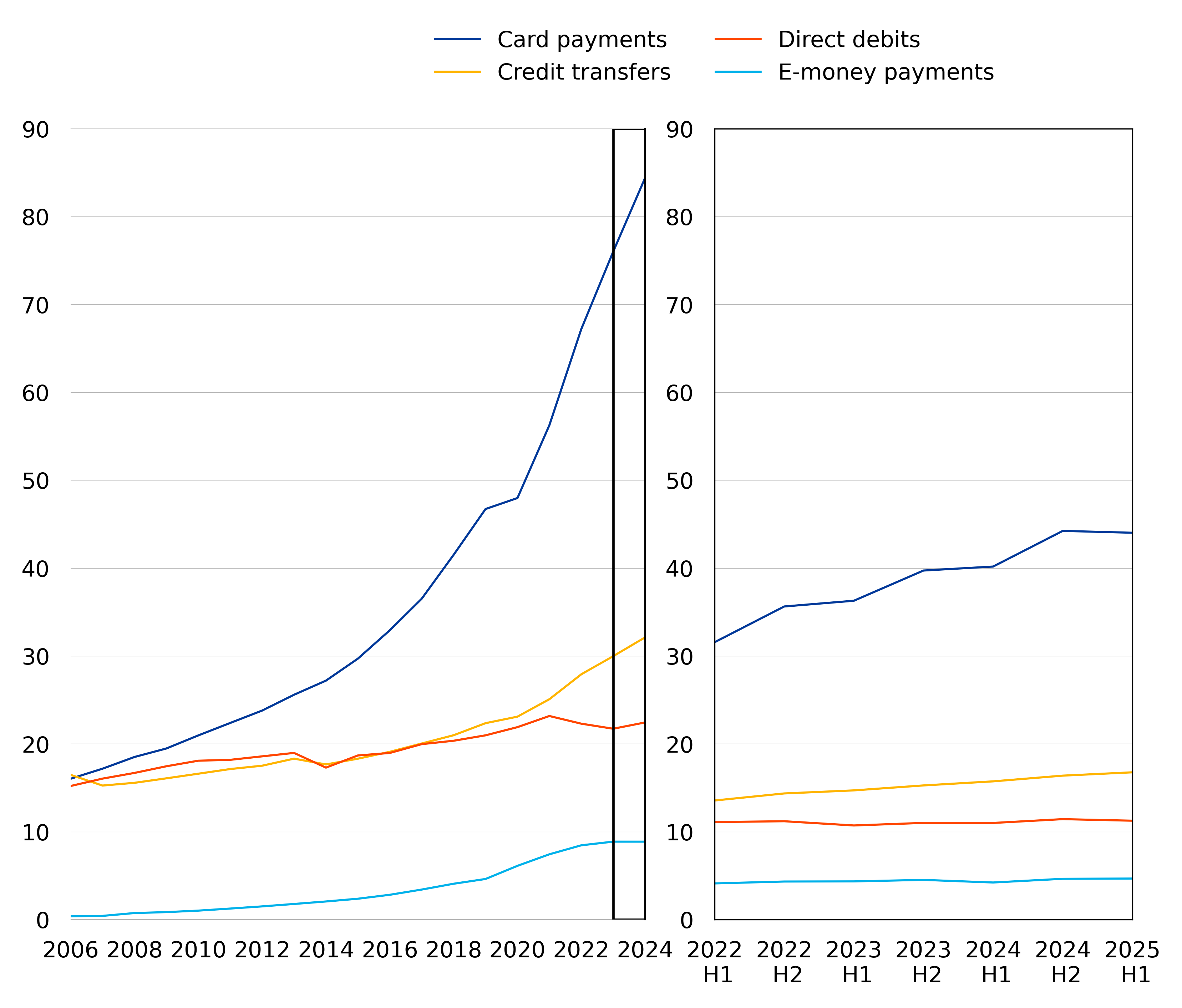
In the first half of 2025 the total number of non-cash payment transactions[5] in the euro area was 77.7 billion, 7.7% higher compared with the first half of 2024, with a corresponding total value of €116.0 trillion, 2.9% higher than in the first half of 2024. Card payments accounted for 57% of the total number of transactions, while credit transfers accounted for 22%, direct debits for 14% and e-money payments for 6%. The remaining 1% comprised cheques, money remittances and other payment services (see annex, Table 1).
Chart 1
Use of the main payment services in the euro area
(number of transactions in billions, graph on the right-hand-side refers to half-yearly data)
Source: ECB.
Note: Data have been partially estimated for periods prior to 2010, as methodological changes were implemented in those years and some data are not directly available. The historical estimations done by the ECB ensure comparability of figures over the entire period. Statistics were also collected for cheques, money remittances and other payment services which together accounted for 1% of the total number of non-cash euro area payment transactions in the first half of 2025.
Card payments
In the first half of 2025 the number of card payments within the euro area was 44.0 billion, 9.6% higher compared with the first half of 2024. The corresponding total value of card payments was €1.7 trillion, 8.7% higher than in the first half of 2024, reflecting an average value of around €38 per payment. The split between remote and non-remote[6] transactions in the total number of card payments was 19% to 81%, while the split in terms of value was 30% to 70%. The number of contactless card payments initiated at a physical electronic funds transfer point of sale terminal was 29.6 billion, 12.8% higher compared with the first half of 2024, with the corresponding total value of €0.8 trillion, 13.9% higher than in the first half of 2024. As a result, their share in the total number of non-remote card payments accounted for 83%, while the corresponding share in terms of value was 67%. At the national level, Portugal had the largest share of card payments as a percentage of the total number of non-cash payments in the first half of 2025, at around 76% (see annex, Table 2).
Credit transfers[7]
In the first half of 2025 the number of credit transfers within the euro area was 16.8 billion, 6.5% higher compared with the first half of 2024, and the corresponding total value was €107.3 trillion, 2.6% higher than in the first half of 2024. As higher-value payments are usually made by credit transfer[8], they accounted for 92% of the total value of non-cash payments. The ratio of transactions initiated electronically to those initiated using paper forms was around 18 to 1, while in terms of value the ratio was around 14 to 1. At the national level, Latvia continued to have the largest share of credit transfers as a percentage of the total number of non-cash payments in the first half of 2025, at around 37% (see annex, Table 2).
Direct debits
In the first half of 2025 the number of direct debits within the euro area was 11.3 billion, 2.3% higher compared with the first half of 2024, and the corresponding total value was €5.6 trillion, 6.2% higher than in the first half of 2024. Of the total number of direct debits, those with an electronic mandate accounted for 12% whereas those with consent given in other forms accounted for 88%, while in terms of value the split was 13% to 87%. At the national level, Germany continued to have the largest share of direct debits as a percentage of the total number of non-cash payments in the first half of 2025, at around 31% (see annex, Table 2).
E-money payments
In the first half of 2025 the number of e-money payment transactions within the euro area was 4.7 billion, 10.7% higher compared with the first half of 2024, and the corresponding value was €0.3 trillion, 13.2% higher than in the first half of 2024. Of the total number of e-money payment transactions, those made with e-money accounts accounted for 98% whereas those made with cards on which e-money can be stored accounted for 2%, while in terms of value the split was 97% to 3%.
Cards and accepting devices
At the end of the first half of 2025 the number of cards with a payment function[9] was 879.3 million, 12.2% higher compared with the number at the end of the first half of 2024. With a total euro area population of around 352 million, this implies an average of 2.5 payment cards per euro area inhabitant.
At the end of the first half of 2025 the total number of automated teller machines (ATMs) in the euro area was around 249.3 thousand, 2.9% lower compared with the number at the end of the first half of 2024. Of these, 34% accepted contactless transactions.
At the end of the first half of 2025 the total number of point of sale (POS) terminals was around 24.7 million[10], 24.0% higher compared with the corresponding number at the end of the first half of 2024. Of these terminals, 93% accepted contactless transactions.
Payment systems[11]
Retail payment systems
Retail payment systems located in the euro area handle mainly payments that are made by individuals and businesses, with a relatively low value and high volume overall.
In the first half of 2025, 35 retail payment systems within the euro area processed around 55.7 billion transactions with a combined value of €26.2 trillion. Instant credit transfers accounted for 23% of the total number and for 7% of the total value of credit transfer transactions processed by euro area retail payment systems.
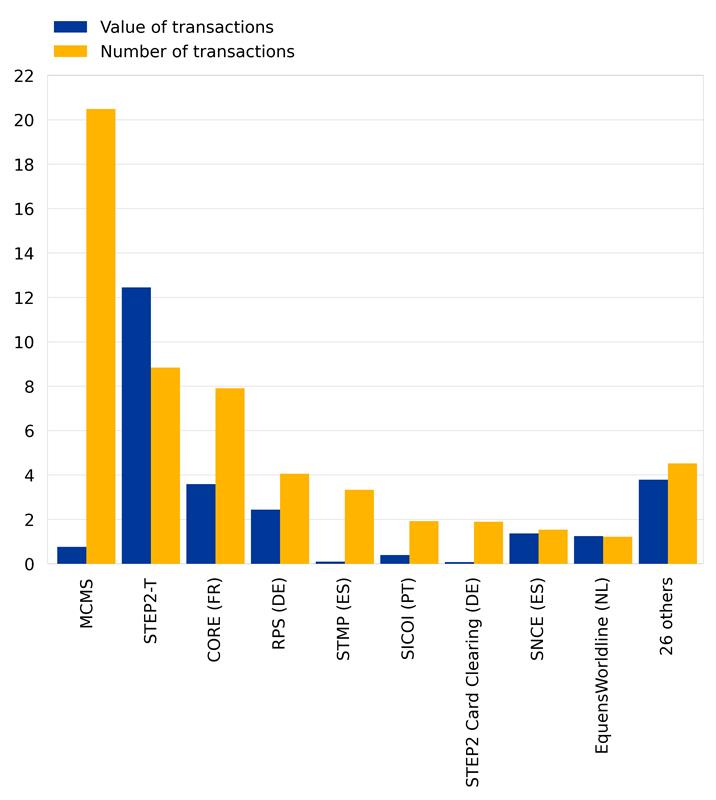
Retail payment systems located in the euro area differ significantly in terms of type, size and geographical scope of transactions they process. The three largest systems (MCMS[12], STEP2-T[13] and CORE (France)) processed 67% of the volume and 64% of the value of all transactions processed by the retail payment systems located in the euro area in the first half of 2025.
Chart 2
Main retail payment systems located in the euro area, values and numbers of transactions processed in the first half of 2025
(value of transactions in EUR trillions and number of transactions in billions)
Source: ECB.
Large-value payment systems
Large-value payment systems form the backbone of the euro area financial market infrastructure and are designed primarily to process large-value and/or high-priority payments made between system participants for their own account or on behalf of their customers.
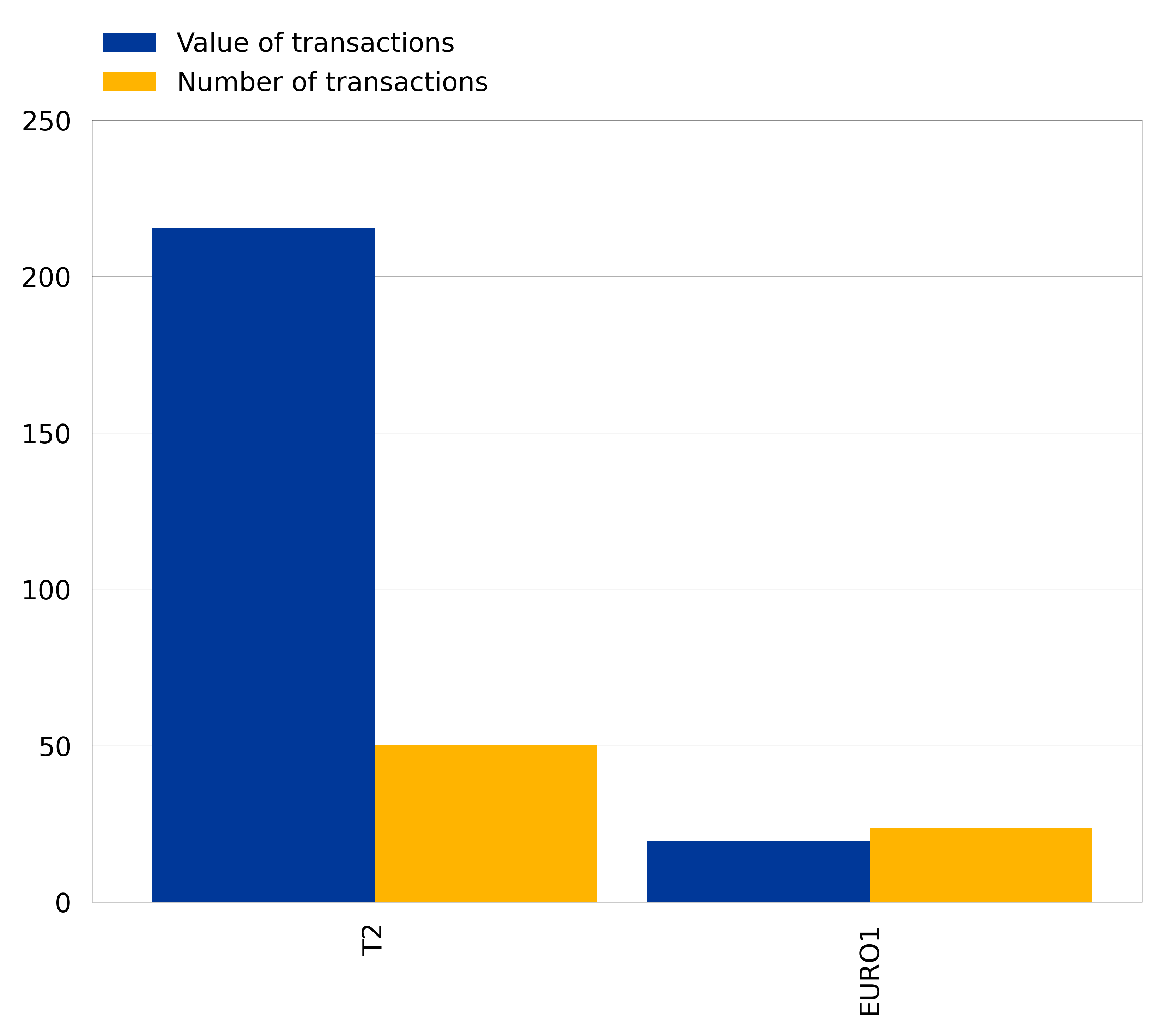
In the first half of 2025, large-value payment systems located in the euro area settled 74.0 million payments with a total value of €235.1 trillion in euro payments, with T2 and EURO1 being the two main systems.[14]
Chart 3
Main large-value payment systems located in the euro area, values and numbers of transactions processed in the first half of 2025
(value of transactions in EUR trillions and number of transactions in millions)
Source: ECB.
Notes:
- The full set of payment statistics can be downloaded from the ECB Data Portal (EDP). The EDP also includes interactive dashboards and interactive reports supporting data visualization. Detailed methodological information, including a list of all data definitions, is available under “Payment services and large-value and retail payment systems” in the "Statistics" section of the ECB's website.
- As of 2025, the dissemination scope of payments statistics in the EDP has been extended in two-waves. Since March 2025, the quarterly publication of payments statistics has been significantly widened, offering more detailed geographical breakdowns as well as additional details on card payments per type of merchant category codes (MCC). As of July 2025, the semi-annual publication includes details on the payment schemes for credit transfers and direct debits as well as more granular geographical breakdowns, among others. In addition, some indicators related to fraudulent payment transactions are now publicly available in the EDP. For the latter, please also refer to the relevant disclaimer available towards the bottom of the EDP page.
- Taking effect on 1 January 2022, the methodological and reporting framework for payments statistics was enhanced to take progressive developments in the payments market and related changes in the legal framework in Europe into account. The enhanced reporting requirements are set out in Regulation ECB/2020/59 amending Regulation ECB/2013/43 on payments statistics and in Guideline ECB/2021/13 on reporting requirements on payments statistics. In addition, the Manual on payments statistics reporting is available on the ECB’s website.
- Hyperlinks in the main body of the press release and in annex tables lead to data that may change with subsequent releases as a result of revisions. Figures shown in annex tables are a snapshot of the data at the time of the current release. Unless otherwise indicated, statistics referring to the euro area cover the EU Member States that had adopted the euro at the time to which the data relate.
Legal Disclaimer:
EIN Presswire provides this news content "as is" without warranty of any kind. We do not accept any responsibility or liability for the accuracy, content, images, videos, licenses, completeness, legality, or reliability of the information contained in this article. If you have any complaints or copyright issues related to this article, kindly contact the author above.
